Meta Title
How Generative AI Is Transforming Enterprise Operations & Growth
Meta Description
Discover how generative AI is transforming enterprise operations through automation, AI agents, RAG, intelligent workflows, content generation, and smarter business solutions.
How Generative AI Is Transforming Enterprise Operations and Business Growth
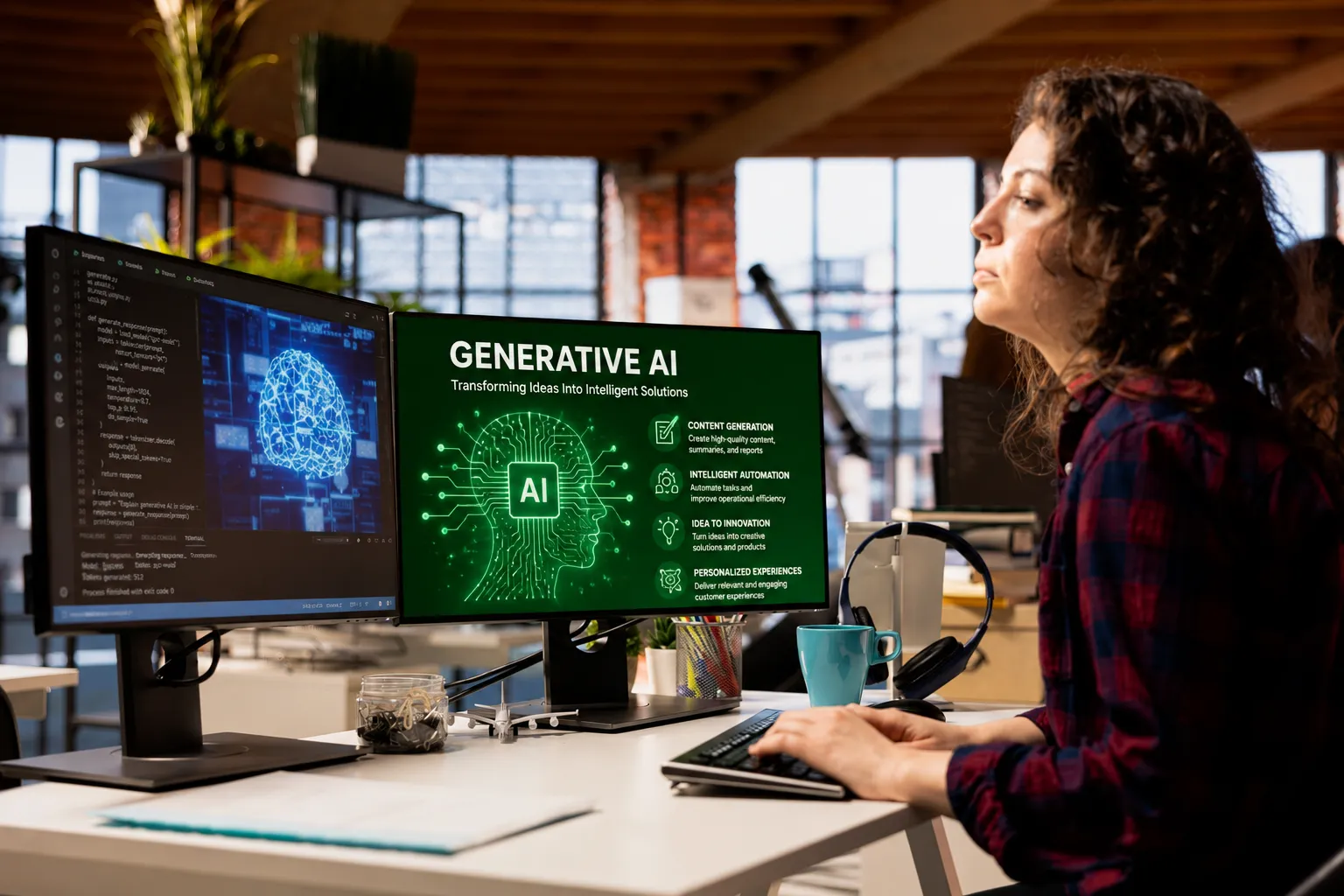
Generative AI is changing how businesses create content, manage information, communicate with customers, and automate everyday processes. What started as a technology associated mainly with chatbots and content generation is now becoming part of enterprise applications, internal workflows, customer support platforms, and intelligent automation systems. Businesses exploring Generative AI Development Services India can use modern AI technologies to create customized solutions that align with their data, workflows, and long-term business objectives.
Unlike traditional software that follows predefined rules, generative AI can understand natural-language instructions and produce new outputs such as text, summaries, code, images, reports, and conversational responses. When integrated properly with enterprise systems, these capabilities can help organizations improve productivity while creating new digital experiences.
What Is Generative AI?
Generative AI refers to artificial intelligence systems capable of creating new content based on patterns learned from large datasets.
Modern generative AI applications can be designed to perform tasks such as:
-
Generating business content
-
Summarizing documents
-
Answering customer questions
-
Creating software code
-
Analyzing information
-
Producing recommendations
-
Supporting employees
-
Automating repetitive workflows
Large language models are one of the most common technologies behind generative AI applications. However, enterprise solutions often combine LLMs with databases, APIs, retrieval systems, AI agents, and business applications.
Why Businesses Are Adopting Generative AI
The biggest opportunity for businesses is not simply producing AI-generated content. The greater value comes from integrating AI into processes that consume significant amounts of time and resources.
Automating Repetitive Tasks
Employees often spend hours drafting emails, summarizing documents, preparing reports, searching for information, and responding to repetitive questions.
Generative AI can assist with these tasks and allow employees to spend more time on strategic and creative activities.
Improving Customer Experiences
AI-powered assistants can interact with customers around the clock.
They can answer common questions, provide product information, summarize conversations, and assist support teams with relevant information.
When connected to approved business data, these assistants can provide more context-aware experiences.
How Generative AI Is Transforming Enterprise Operations
Generative AI can influence almost every department when implemented around practical business requirements.
Intelligent Knowledge Management
Large organizations often have information spread across documents, databases, websites, knowledge bases, and internal platforms.
Generative AI combined with retrieval technologies can help employees search this information using natural language.
Instead of manually searching through multiple documents, employees can ask a question and receive a response based on relevant enterprise information.
Faster Content Production
Marketing and communication teams can use generative AI to create initial drafts of blogs, product descriptions, campaign concepts, emails, reports, and social media content.
Human review remains important, but AI can significantly reduce the time required for repetitive content tasks.
Smarter Document Processing
Businesses handle contracts, invoices, proposals, applications, reports, and other documents every day.
Generative AI can help extract information, summarize lengthy files, classify documents, and answer questions about their contents.
This can reduce manual processing and improve access to important information.
Generative AI and AI Agents
The next stage of enterprise AI goes beyond simple question-and-answer systems.
AI agents can use generative AI models to understand objectives, interact with tools, retrieve information, and complete multiple steps within a workflow.
For example, an enterprise AI agent could receive a customer request, retrieve information from a CRM, check an internal knowledge base, prepare a response, and send the information through an approved workflow.
This creates opportunities for businesses to automate more complex processes while maintaining appropriate human oversight.
The Role of RAG in Enterprise Generative AI
Generative AI becomes more useful when it can access relevant business information.
Retrieval-Augmented Generation, or RAG, allows an AI application to retrieve information from external knowledge sources before generating a response.
This can help businesses build applications that work with their own documents, policies, product information, and internal knowledge.
RAG can also reduce the dependence on static model knowledge by providing current information as context during a user interaction.
Building Secure and Scalable GenAI Solutions
Enterprise AI requires careful planning.
Data Security
Businesses may process confidential documents, customer information, intellectual property, and internal communications.
AI systems should therefore be designed with appropriate authentication, authorization, encryption, data access controls, and governance.
Scalability
An AI application that works for a small number of users may require significant infrastructure changes when usage increases.
Scalable cloud infrastructure, optimized APIs, efficient model selection, caching, and monitoring can help businesses manage growing workloads.
Output Quality
Generative AI can sometimes produce inaccurate or inconsistent information.
Businesses should use appropriate evaluation processes, retrieval strategies, prompt controls, validation, and human review where necessary.
Why Hire Dedicated Developers India for Generative AI?
Generative AI projects require continuous development. After launching an application, businesses may need new integrations, model optimization, additional features, security improvements, performance monitoring, and workflow automation.
Companies that Hire Dedicated Developers India can establish a focused technical team for long-term AI development.
A dedicated team can work closely with business stakeholders and continuously improve the AI application based on user feedback and changing requirements.
This can be especially useful for organizations planning to build multiple AI applications rather than launching a single short-term project.
Why Choose a Software Development Company?
Generative AI is only one component of a complete enterprise solution.
A production-ready AI application may also require backend development, databases, APIs, mobile or web interfaces, authentication, cloud infrastructure, analytics, testing, and third-party integrations.
An experienced Software Development Company can combine these components into a complete technology solution.
This approach can help businesses integrate generative AI into existing CRM, ERP, e-commerce, customer support, document management, and internal business platforms.
Why Choose Rushkar?
Rushkar develops customized generative AI solutions designed around specific business requirements.
Its capabilities include generative AI applications, GPT-based solutions, AI assistants, multimodal AI, enterprise integrations, workflow automation, content-generation systems, and production-ready AI implementations.
Rushkar focuses on moving beyond experimental AI by developing solutions that can be integrated into real business environments. Its service offering also covers areas such as LLM integration, RAG, AI agents, API integration, scalability, performance optimization, and ongoing maintenance.
The Future of Generative AI in Business
Generative AI is likely to become increasingly integrated into everyday enterprise software.
Instead of opening a separate AI application, employees may interact with AI directly inside CRM platforms, project management systems, customer support applications, communication tools, and business dashboards.
AI agents, multimodal models, RAG, LLMs, and workflow automation will continue to expand the capabilities of these systems.
The businesses that benefit most will be those that focus on practical applications, reliable data, security, measurable outcomes, and continuous improvement.
Conclusion
Generative AI is transforming enterprise operations by helping businesses automate repetitive work, improve knowledge access, create personalized experiences, process documents, and build intelligent workflows.
However, successful implementation requires more than selecting an AI model. Businesses need the right architecture, data strategy, security framework, integrations, scalability, and ongoing optimization.
Ready to transform your business with Generative AI? Partner with Rushkar to build secure, scalable, and production-ready AI solutions tailored to your business needs. Contact Rushkar today and discover how Generative AI can help your organization improve productivity, automate operations, and unlock new opportunities for business growth.