Most questions are not as simple as they look.
You ask something, expecting a clear answer. Instead, you get a response that feels incomplete. It covers one angle, but not the one you had in mind.
So you try again.
You rephrase. You search somewhere else. You compare different answers just to get a full picture.
That’s where the process becomes inefficient.
The issue isn’t the lack of answers.
It’s the lack of the right perspective.
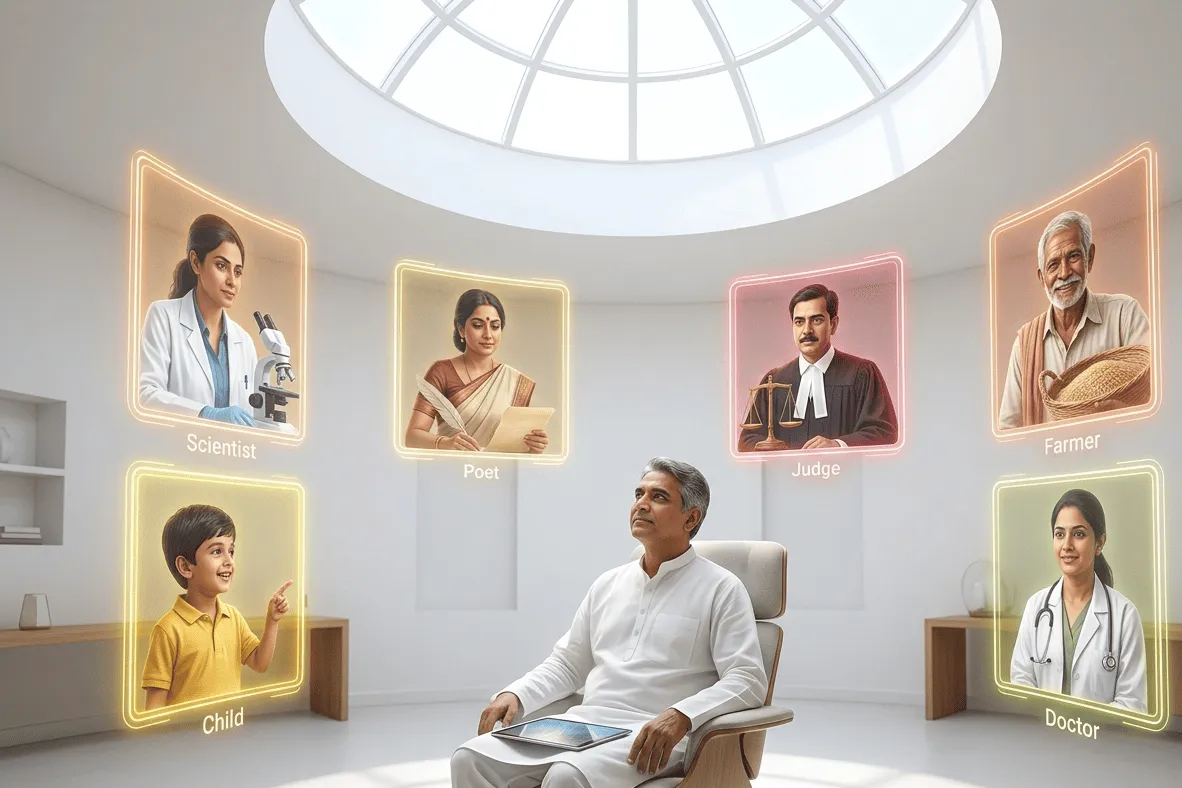
A Multi-Persona AI Platform for All Your Questions solves this by bringing multiple viewpoints into a single interaction. It doesn’t assume what you need. It gives you options so you can find what fits.
One question can have multiple meanings
Two users can ask the same question and expect completely different answers.
“What’s the best way to improve performance?”
For one person, it might mean technical performance.
For another, it might mean team productivity.
For someone else, it could be about personal efficiency.
A single response struggles to handle this.
A multi-persona system handles it better.
It presents different interpretations of the same question.
This increases relevance.
It removes the guesswork from asking questions
Users often spend time figuring out how to ask.
They try different variations just to get the right answer.
That slows everything down.
A Multi-Persona AI Platform for All Your Questions reduces this.
Instead of relying on one interpretation, it provides multiple.
Users don’t need to be precise.
They ask once and explore.
It matches different user intentions
Intent is not always clear from a question.
A multi-persona system bridges this gap.
It presents answers that align with different possible intentions.
This improves the chances of relevance.
Users are more likely to find what they need.
It improves clarity through comparison
Sometimes understanding comes from comparison.
When users see different perspectives, they can evaluate them.
This helps them choose what makes sense.
A multi-persona system supports this.
It doesn’t limit users to one explanation.
It aligns with how people think naturally
People rarely think in one direction.
They consider options. They weigh different ideas.
A multi-persona system reflects this.
It presents multiple viewpoints.
This makes the interaction feel more natural.
It aligns with modern Trends in Artificial Intelligence
AI systems are becoming more adaptive.
They are expected to adjust based on context and user needs.
This shift is reflected in how AI Development Companies are building more flexible solutions.
A multi-persona approach fits this evolution.
It adapts to users instead of forcing a fixed response.
It reduces incomplete answers
Incomplete answers create frustration.
Users feel like something is missing.
A multi-persona system reduces this.
By covering multiple angles, it provides a more complete response.
This improves satisfaction.
It supports better decision-making
Decisions often require multiple perspectives.
A single answer may not provide enough context.
A multi-persona system helps by offering different viewpoints.
This makes it easier to evaluate options.
It simplifies complex queries
Some questions involve multiple factors.
A multi-persona system breaks them down.
Each perspective focuses on one aspect.
This makes complex queries easier to understand.
It reduces the need for external validation
Users often look for multiple sources to confirm information.
A multi-persona system reduces this need.
It provides multiple perspectives in one place.
This saves time.
It improves confidence in answers
Confidence comes from clarity.
If users feel unsure, they keep searching.
A multi-persona system improves confidence.
By offering a broader view, it reduces doubt.
It supports different levels of understanding
Not every user is at the same level.
Some need basic explanations. Others want detailed insights.
A multi-persona system caters to both.
This makes it more inclusive.
It enhances engagement
When users see value, they stay engaged.
A multi-persona system increases value.
There’s more to explore.
Users can interact with different perspectives.
It works across different use cases
This approach is not limited to one area.
It can be used for:
Learning
Customer support
Research
Decision-making
It also fits well with platforms like an AI Interview Platform, where users need different perspectives on interview questions, preparation strategies, and evaluation methods.
It reduces frustration during interaction
Frustration often comes from mismatch.
The answer doesn’t match the expectation.
A multi-persona system reduces this.
By offering multiple perspectives, it increases the chances of relevance.
Why this matters now
User expectations are changing.
People want:
Clear answers
Relevant insights
Flexible explanations
Systems that can’t meet these expectations feel limited.
A Multi-Persona AI Platform for All Your Questions addresses these needs.
A better way to answer questions
At its core, this approach improves one thing.
How answers are delivered.
From single responses to multiple perspectives.
From guesswork to clarity.
From incomplete answers to a broader view.
That’s what makes it effective.
It doesn’t just answer questions.
It brings the right perspective to every question.
And that’s what makes the difference.